Thursday, January 10, 2013

#9—Would You Like a Smile with That?

Even the smallest of businesses
has a real person behind it.

26 Expressions of Love and Kindness Plus 1
#9—Would You Like a Smile with That?

            Have you ever worked on the employee side of a counter waiting on customers?  Maybe it was in a fast food restaurant.  Maybe it was as a retail cashier.  Maybe it was as a janitor in a busy building or a receptionist in a office.  If so, did you find days were you felt like you were treated like an object rather than a person?  How often do you do that to people who serve you in their jobs?

            To be honest, it is understandable.  We are busy.  We go to the store to get what we need.  We go to a restaurant to get food.  We do not go to find an everlasting friendship with the person who is taking our money.  However, that can happen.  Then what can you do to express love and kindness to someone you barely know and may never see again?

            How about one of these:

            1.  Smile and look at the cashier/waiter/waitress in the eye and say, "Hello.  How are you today?"  Then actually listen to the answer.

            2.  Sincerely thank this person for his/her help and wish him/her to have a good day.

            3.  If a snafu happens with your order or you have to wait longer because of a snafu with the person ahead of you, patiently wait and calmly respond, "That's o.k.  I understand.  Things do not always happen like they are suppose to."

            4.  Call the person helping you by name.  Hint:  look at his or her name tag.  If he/she is not wearing a name tag but is someone who has often helped you, ask.  "I see you here all the time, what's your first name?"  Then use his/her name that day and each time you go to that establishment in the future.

            It is simply a matter of remembering that they are not robots or an appendage of a business.  It is remembering that they, too, are people with frustrations, worries, and hopes.  They, too, want the same respect and treatment that you would like to receive. 

            So, the next time you go into a business, instead of just expecting someone to make you feel better about shopping there, plan to make an employee have a better day by expressing a little kindness.  As you are parting from your "cashier," pretend you are asking, "Would you like a smile with that?" and then give him or her huge grinning goodbye as you purposely comment, "Have a wonderful day."

#8--No Effort


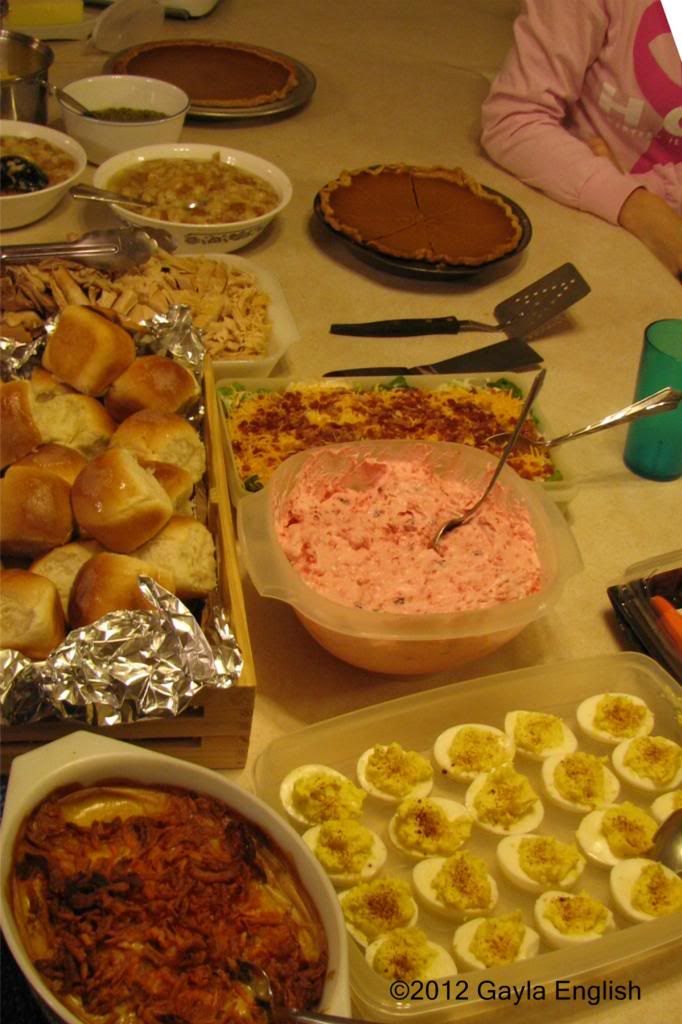
Unfortunately, this isn't my doing;
it is part of Thanksgiving fixin's.
26 Expressions of Love and Kindness Plus 1
#8—No effort

            One of the favorite gifts I received when I gave birth to most of my children was a meal brought in for my whole family.  It was just what I (and my family) needed, and we all loved it.  We never knew what we were going to get, but every meal touched my family with a big helping of love and kindness.

            Consequently, one of the things I most often think about giving to other people, especially people going through a difficult time or even just an adjustment, is a meal.  However, I am ashamed to say that I rarely follow through with this grand idea.  My primary excuse is that I am not that great of a cook, and I do not want to disappoint someone.

           Even so, I have found a simple way to fulfill this plan with no (or only a little extra) effort.  That is:  just double the meal I am making for my family and deliver the extra to the family on my mind.  How easy is that?  This is very doable.  Now if only I could remember to follow through with it.  How about you?  Can you touch a family with a warm meal wrapped in love and kindness?  Will you actually do it?  Tell me about it.  Give me some inspiration to do this on a regular basis.  Once it becomes a habit, it truly will seemingly be no effort.

Tuesday, January 8, 2013

#7--Short and Sweet


26 Expressions of Love and Kindness Plus 1
#7—Short and Sweet

            Sometimes we just need to keep it simple.  Touch your family and other loved ones by simply telling them--and meaning--I love you.  In person is the best way, but you can even surprise them by leaving it written somewhere to find.  I did that tonight for my daughter who is too far away tonight to tell it to in person.  Want to see it?  Look in the comment section of her December 31, 2012, blog at More Like Home.

Monday, January 7, 2013

#6—Nighttime Niceness


26 Expressions of Love and Kindness Plus 1
#6—Nighttime Niceness

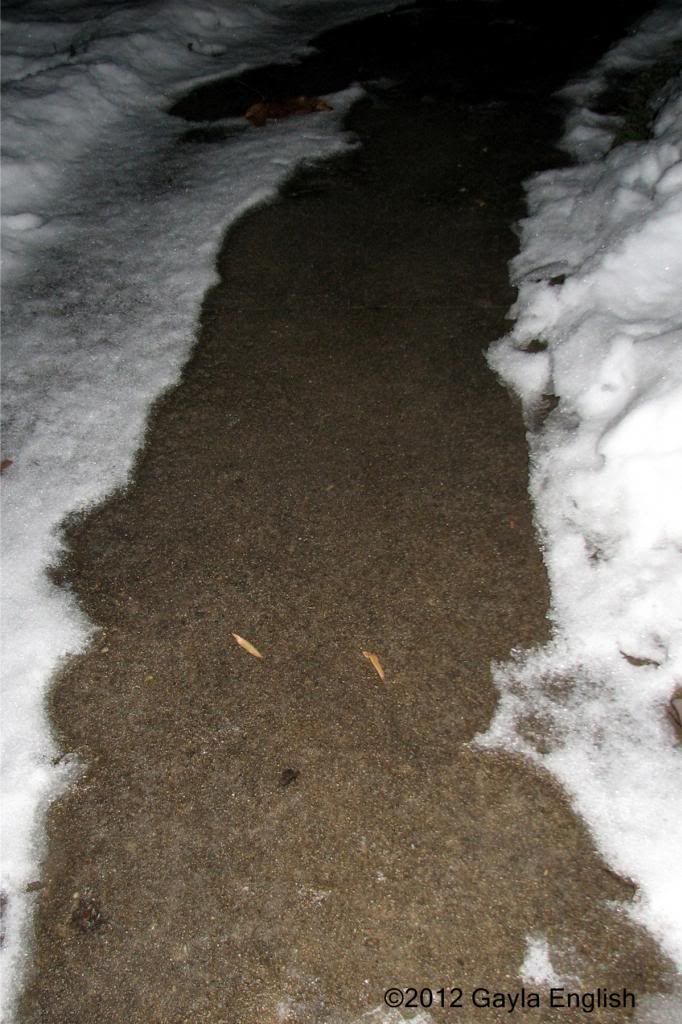
            I do not know about the weather in your area, but just before Christmas we had a nasty one-day storm come through here, stranding people and touching families all over the county.  Since then we have had a couple of more snow falls, but nothing to cause us to work up a tizzy. 

            During any of these times, wouldn't it have been wonderful to walk out to a pre-shoveled sidewalk in front of the house?  What an expression of love and kindness that kind of surprise would be?!  You can bestow that kindness to your neighbor the next time it snows.  Better yet, do it at night or at a time when you know your neighbor will be gone!  This type of kindness does not have to be rewarded with a face-to-face thank you.  Knowing you eased someone else's burden can be thank you enough.

            One year we had a neighbor down the block do this for us.  We finally figured out who did it, but our family was touched by his expression of  kindness even before we knew who was responsible.  If shoveling (or snow blowing) a sidewalk does not fit into your routine, what other type of nighttime niceness can you do?

Saturday, January 5, 2013

#5—Politely Address an Irritation Before It Becomes a Problem

Blue because you don't know what to do?

26 Expressions of Love and Kindness Plus 1
#5— Politely address an irritation before it becomes a problem

            It seems that families are either touched by abrasive, in-your-face talk or quiet, seething, unspoken resentment.  Consider a balance of these two extremes as a way to express love and kindness in a family.

            Most people want to avoid confrontation.  Yet, which of the following is less confrontational? 

            1.  Expressing a concern or irritation in its early stages while you still have self-control of your temper or

            2.  Waiting until you get to the point that you cannot take it anymore and you cannot stop reciting all your complaints long enough to listen to the other person (or you get so upset with someone that you vow never to talk to or do anything with that person again without telling him or her why you are no longer a friend)

            On paper, the first way should sound like the better choice.  In practice, however, too many people choose the second method, and they do it in the name of "kindness."  They think saying "nothing" is more kind than saying something that might make someone else uncomfortable.

            Think of it this way.  If you say "nothing" to others, what are you thinking every time they repeat the "offense" that they do not realize is offensive?  Are they bad thoughts?  Does your anger grow each time?  Do you start expecting them to figure out what they are doing wrong even though you have not told them?  (such as, "Can't he figure out by now that I can't stand it when he does that?"  "Why does she keep doing that when it irritates me so?")  Are these expectations fair?

            For example, during this past year, as a result of some volunteer work I do, I had to intervene or help with the beginnings of problems.  One situation involved the behavior of a little girl.  Since she was still in the beginning stages of learning appropriate behavior and responses to the children around her and the adult leading fun time, it was much easier to talk briefly with the mom (and grandma) about what we could do to make her time in the class more enjoyable for everyone.  Letting everyone understand expectations early was much easier than waiting until she had established a pattern of verbal and physical misconduct that would be difficult to change or waiting until she had been a problem so long that her leader had run out of patience and tolerance with having her in class.  In short, a small irritation that was quickly heading towards a big problem was stopped and re-routed so that everyone involved could stay on friendly terms and enjoy (rather than dread) seeing each other.

            The key to early intervention is to approach everyone involved with love and kindness, showing you care enough to maintain a good relationship.  This approach touches both families and non-family members in a way that makes relationships stronger for the long haul.

#4—Leave Your Mail Carrier a Treat


26 Expressions of Love and Kindness Plus 1
#4— Leave Your Mail Carrier a Treat

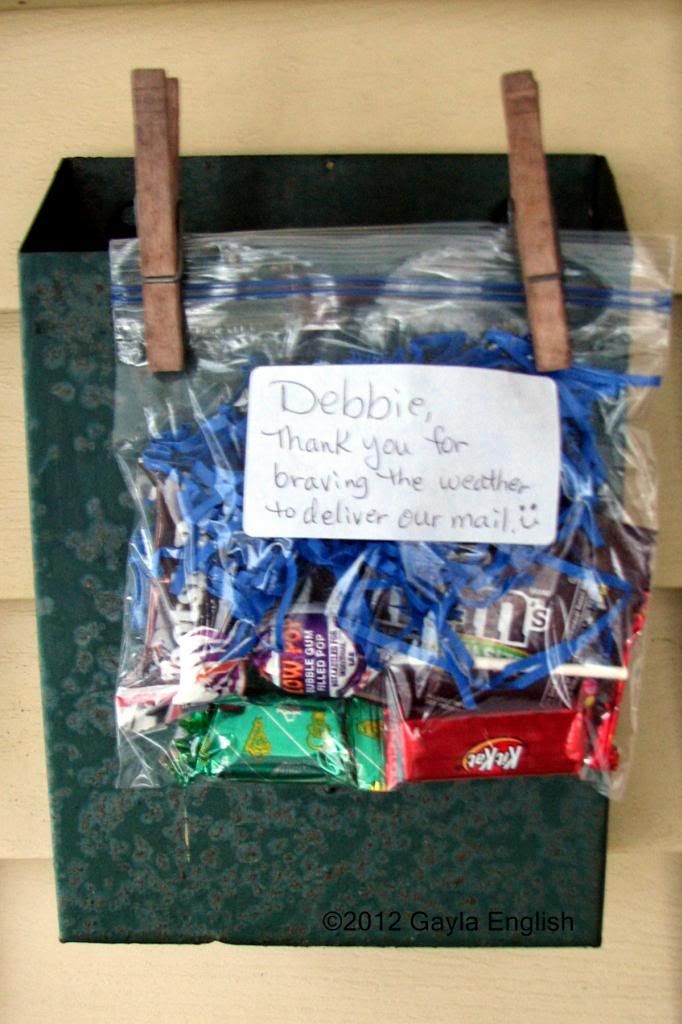
            Although the postman's pledge might be "Neither rain, nor snow nor sleet nor gloom of night stays these couriers from their appointed rounds," that does not mean that your very human mail carrier suddenly becomes super human when he or she dons the official uniform.  In other words, sometimes it is just plain miserable to be out in the weather delivering mail, so do something very simple to put a smile on your postman.

            It can be a simple Ziplock sandwich bag with a little treat—homemade or store bought—clipped with a clothes pin to your mailbox.  Maybe you can put a pack of hot chocolate (to be used after rounds) or flavored tea bags in a decorated bag with tissue paper with a note on the outside saying it is for your postman.  If you know his or her real name, then put that on it.  Neither of these ideas may work in your situation, but hopefully it will trigger an idea that will work for you.

            It does not have to be fancy or cost much.  An unexpected, simple expression of thanks and gratitude can put a positive touch on an otherwise humdrum day and be received as a true expression of appreciation and kindness.

Thursday, January 3, 2013

#3—Don't Ask for too Many Favors


26 Expressions of Love and Kindness Plus 1
#3—Don't Ask for too Many Favors

            Although we should be more than willing to share with others (as mentioned yesterday), we should not be anxiously looking for unnecessary handouts.  This is not the same as humbly accepting help that is offered.  In fact, one way we can positively touch other families is to allow them to share with us when they may feel inspired to do.  This is different than taking on the attitude that we are entitled to receive gifts from others.

            I do not feel I am explaining myself very well.  Let me give you this example.  One year in school my assigned seat for one class was always next to a boy who never brought paper to class.  The first time he asked to borrow a piece of paper I gladly passed a piece to him.  The next day he still didn't have any paper.  He said his mom hadn't been able to go to the store, so I smiled and gave him another piece.  This continued on days the teacher did not give us worksheets.  The next week (or the week after that) I asked him when his mom was going to the store.  He told me she had bought paper, but he had forgotten it.  By this time, I grudgingly gave him paper.  Then a few times, I refused.  I suppose I refused because I thought I was being taken advantage of.  If his mom could not afford paper, the least he could do was write smaller (not big and sloppy) and carefully take care of my paper so he could take notes on the back, too.  That didn't happen.  However, I went back to giving him paper—one sheet at a time—because when I didn't, he did not take any notes (and no one else would give him paper).  This is not a very good example either.

            Let's look at it this way.  I resented his continual requests because (still being a child and not being able to see the bigger picture) I felt he was being careless and irresponsible.  I was cheerfully willing to help someone in a "pinch" even if it happened more than once, but I felt like he was not even trying to do what he needed to do to have.*  I do not want to make others feel like my requests for favors are a continual burden, so as one expression of love and kindness, my goal is to not ask for too many favors.  This way when I do ask for help the other person is touched by having a chance to reap the satisfaction of sharing with someone in a pinch and not feel like he or she is being taken advantage of.


            *I continued to give him paper the rest of the school year because I think somewhere in my conscious I knew his mom probably had not bought him paper and barely provided him with enough clothes to wear—barely.  Telling this story actually makes me feel selfish, but other stories that come to mind of people lazily taking advantage of others with their requests are too "fresh" to put into print at this time, especially when the point I am trying to make is not what others did but how I want to approach friends with my needs when they arise.