Tuesday, June 26, 2012

Homeschool Myths

      While waiting for my next original entry (sorry, I have misplaced the article I am going to discuss), you might want to pop over to this blog to read Common Homeschool Myths Dispelled.  I have not read any other entries in this blog, but the I-can't-homeschool reasons listed are comments I have heard many times.  If you have made these same comments, you might find the answer for which you are searching.
      You might say, "This doesn't touch my family, because I have no desire to homeschool."  However, I would encourage you to read it anyway, so you can have a better or more complete snapshot of the possibility of homeschooling.  Besides, if you have felt awkward saying ones of these comments to a homeschooling mom, you can now have the "answer" without asking!
      I would love to hear if one of the myths or if one of the "answers" touches your family.

Saturday, June 23, 2012

I am not having much luck lately working on Touching Families.  Before my computer problems, I began to get a "cold."  I am just now starting to shake it.  It clogged all of my sinuses and moved into my chest.  By the time I fulfilled all my regular responsibilities, I was too wiped out to write.  The first part of 4-H contests are Monday, so that has everyone in the house buzzing.  Even so, look for a new entry soon.

This entry was posted on my facebook page for Touching Families.  When I have miscellaneous comments or updates such as this, you can check http://www.facebook.com/TouchingFamilies.

Tuesday, June 12, 2012

Touched by Technology


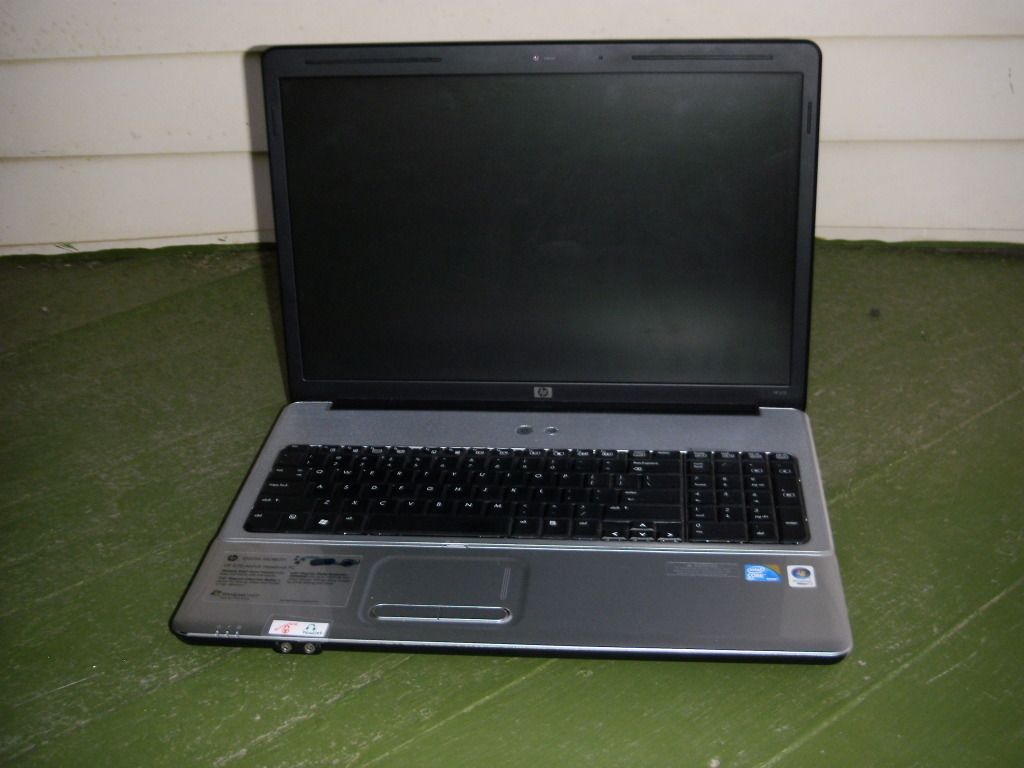
            Every family is touched by technology.  For some families, technology dominates the home to the point mom calls everyone to dinner with a text.  My family is far from that, but I (and this blog) have recently been given a kick in the gut by my laptop.  Compound that with my being home only one day out of the last 10 days, and I feel both lost and frustrated.  Thankfully, God has revealed an object lesson to me through all of this.
            Over the last few months I have realized that problems with my laptop's DVD player are not just flukes with particular CDs or my complete incompetence.  My first conclusion was that the hardware itself needed to be replaced.  I did not think we could afford to repair that at this time.
            Since we have to spend our money carefully, I try to take good care of my laptop, even though I take it many places with me.  My laptop case is rather big and bulky.  I like to have with me everything I might need for it, and I believe it provides extra protection for my laptop.  Despite these precautions, I know that sometimes equipment just quits working. 
The guilty party
            Accordingly a week ago when I was in a large town, I went to the local Best Buy to get a very rough estimate on replacing my DVD burner.  To my amazement, I learned that my problem sounded like a software filter problem that sometimes occurs if more than one program uses the DVD burner and could be fixed in as little as 30 seconds.  Woo hoo!  But that wasn't my problem.  It was a software problem.  Just not a 30-second problem.
            Apparently my laptop had gotten a virus at some point.  Fortunately, my anti-virus software evidently successfully removed the virus, but in the process it also removed codes from my Windows 7 operating system.  Those "holes" made my computer incapable of locating and/or using my CD/DVD equipment and probably caused other problems that I did not yet realize existed.  The technician said that fixing the problem would endanger all my files, and he recommended the price package that would include his backing up my files and restoring them, which would mean an additional $100 on top of the repair itself. 
            Being the cautious person I try to be, I had backed up my laptop at 5:30 that morning before leaving town.  At home I have an external hard drive just for my laptop.  That morning I watched little numbers race across the screen until the symbol turned green and declared, "Backup Complete."  The program is able to detect all the changes since my last backup and save the changes accordingly.  Then when I need to restore, I just hit the restore button.  Well, it's supposed to be that easy.  So, when the technician gave me a choice, I told him I couldn't do the repair if I had to pay the extra $100, so it was a good thing I had done my own backup.  I only needed to put a couple of things on my thumb drive, which were files I had created after the backup, before I handed it over.  I was disappointed at not having my computer the rest of the day, but it was going to be worth it.  J
            The next day I picked up my laptop, they showed me that the DVD player was working, and they loaded Adobe's free Acrobat Reader, which I was going to need the rest of the day.  However, the rest of my programs were at home, and I would not be anywhere with internet access until I got home.  I was soon glad to get home and get my laptop going before I would be on the road again that night. 
            I began loading programs…well, attempted to load programs.  Apparently since my previous Windows 7 was an upgrade from Vista, it wasn't quite full functioning.  Now it has a full Windows 7 program without pieces of Vista interfering.  As a result, at least two programs got notices of being incompatible.  One would not fully load; the other seemed to load anyway, but I can't try it because I could find upgrade #3 and not #2.  Without #2 I can't fully try it.  I still have to contact customer support.  Of course, I have to redo all my settings for the programs that did load.  I still have at least 3 more programs to put back on my laptop.  
            Then came the moment of truth:  getting all my files back on the computer.  I attached the external hard drive, let the program automatically load, and waited for the restore menu to pop up.  It didn't.  All the other parts were still in the menu, just not restore.  I manually looked in the hard drive.  I could find some files I had manually backed up, but that was all.  The newest "My Documents" folder I could find was July 2011.  Fortunately, the majority of work I had done on my laptop the past few months dealt with Classical Conversations, and I had copied those files to my desktop computer two weeks ago.  I will have to redo some documents—the ones I know I'm missing, but it could be worse.  I am home again and still feel like I'm stuttering with everything I'm trying to do.
            This is going to be a headache one way or another for days (or weeks) to come—just like being part of a family.  In fact, many parts of my computer situation are similar to life with a family.  I thought I had done all the right things to protect my computer and its contents.  I had a sturdy carrying case and had a highly recommended anti-virus software in place. 
            We try to protect our families, too.  We give our children boundaries—sometimes even physical fences—and warn them of potential dangers.  It may look like we are doing everything right, but somehow a bad influence, attitude, or habit stealthily invades and touches our family, just like the computer virus secretly invaded my laptop.  You may not notice the intrusion at first.  Some little things may not make sense, but you brush it off completely or consider an inappropriate comment or a misspoken truth as a fluke, just like I blamed a "scratched or locked" CD as my DVD problem.
            I finally had to face the fact that I truly had a problem with my laptop.  I did not like the big problem it appeared to be.  Eventually, we have to face the fact that a real problem has invaded our family or the lives of our children.  The problem may look too big to handle.  When we seek help, the initial guidance we get may be promising and lead us to believe it's a quick fix, just like I thought I had a 30-second fix to my DVD issue.  The transition through repairing damage done to a family member (or the family as a whole) to a new and a better level of a relationship can be difficult, time consuming, and full of anxiety.  The days I waited for my computer and went without access to any type of functions or information I got with my laptop was mildly difficult and left me a little anxious. 
            That was nothing compared to the healing that needs to happen in a family, but just like I thought everything could quickly go back to normal after I got my laptop home, a family can also wrongly think everything will quickly go back to normal after a big problem has been "corrected."  Rarely does everything go back to the seemingly carefree days before the problem occurred. I have to be patient while I continue to go through the adjustment of trying to get my files and programs the way I want them, but I also have to realize it's not going to be exactly the same as it was before.  In our families, we need to be patient, too, and remember that even though it is not the way it was before, it does not have to be.  We can move on to some new "good."
            Technology never stands still but keeps moving to the next "better" level.  Families can, too.  Families were here before technology, and families will exist even if the world's power grids permanently fail.  Each of us may be touched by technology, but it can never outdo the power of families.

Sunday, June 3, 2012

What about me?


            Although no writer can write anything completely unbiased, I tried to keep most of my personal choices out of the "Are You Mom Enough" series.  I wanted you to think about yourself as you read those articles.  However, honesty and some self-disclosure are most people's expectations when they follow a blog writer as opposed to reading a national newspaper.
            Consider this entry as a way for you to get to know me a little better, not a means of comparing yourself to me.  Constant comparison can eat away at you.  The insecurities and self-doubts caused by my comparing myself to "perfect" moms touched my family more than my inadequacies themselves.
            Did I breastfeed or bottle feed?  Both.  My first pregnancy was twins.  The doctor said I should be able to produce enough milk to feed both of them.  I did not know if I believed him, and I did not know if I wanted to make that much of a commitment to basically nurse—in my opinion—24 hours a day, especially since I had a husband who was willing to help with the bottle feeding.  From the beginning we did both with the girls.  Sometimes they would both get nursed and bottle fed in one feeding.  Other times one would only get breastfed and the other only bottle fed; the next time, they reversed.  I tried both ways, but I don't honestly remember which we ended up doing the most.  One girl liked nursing better; the other, bottle feeding better.  However, they learned to deal with whatever they were given. 
            Although I like to think I breastfed them for three months, it may have actually been less than that.  If I had known more about breastfeeding, it would have been longer.  Less than a month after they were born I had to finish my last six weeks of my student teaching.  I didn't really have a place or time to pump, so I didn't.  That was a mistake.  Even if I didn't want to save it to take home, I should have relieved the pressure and kept my milk production even.  You live and learn.  We then went to total bottle feeding, which worked out fine and was not that difficult to maintain. 
My kids:  by birth, marriage, and grandchild
            The other five children came one at a time, so I planned to nurse them.  For the most part, breastfeeding was much easier, especially since I was willing to nurse anytime anywhere as long as I had a receiving blanket or something to use as a cover up. I nursed each one for about a year with breast milk being their only nourishment for the first six months.  However, I should have given them a bottle a little more often, because most of them never quite got used to one.  Although my children usually go where I go, I was away from one daughter for a whole day when she was a few months old.  I left bottles of expressed milk, but she would not take it at all, which meant she cried half the day.  She was older before I left her that long again.
            Did I feed on demand or on a schedule?  Pretty much I fed on demand.  I tried feeding more than one of my children on a schedule, but I didn't have a lot of luck.  The mom has to be committed to a schedule first, and that didn't happen.  However, I was not opposed to making them wait a little while if I didn't think they were really hungry (or were using me as a human pacifier) or if it was not a good time/place to feed them.
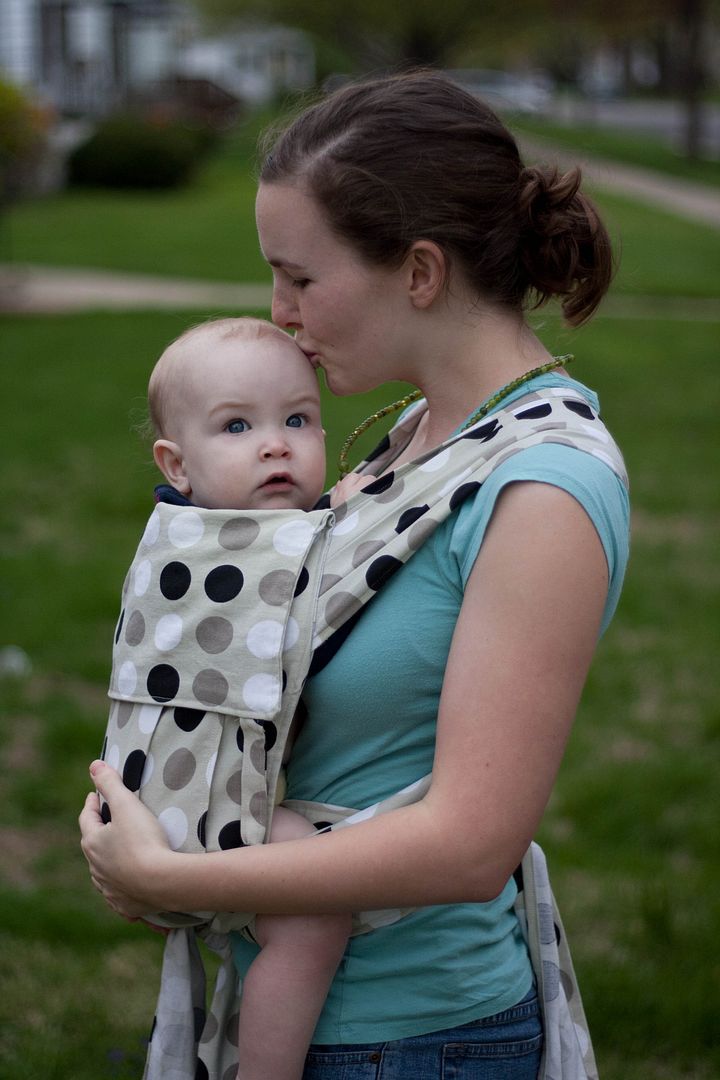
            Did I wear my babies?  I carried my children around a lot on my hips and got some nice biceps without having to work out.  (Sadly, the biceps went away completely since I don't carry my children around anymore.)  When the twins were babies, I laid them on blankets on the front room floor, in a playpen, or propped up in their high chairs when they were older if I was in the kitchen.  My twin stroller did not have a "lay-them-down" option, which I used for other children even in the house when I got a different stroller.  With my second pregnancy, I bought a sling at a craft show where I had a booth.  I had the stroller with me, but she wanted to be held and her continual weight was killing my arms.  La Leche League was selling slings in the booth next to me.  I bought one.  I used it that day and other days at home and while out and about.  I really didn't use it that often, but when I did, I was glad I had it.
            Did I co-sleep with my children?  Basically for the first three months, I gradually eased my children from sleeping mostly with me to sleeping mostly in a bed by themselves in a room down the hall.  Even though I could probably hear them without it, I used a baby monitor to signal me for nighttime feedings.  As they got older, my husband taught them to need special attention before they went to sleep, but that's another story.  J  I know some parents who welcome their children to their bed at any time and at any age.  I know a set of parents that did not allow their children to step foot inside the parental bedroom at any time for any reason, but they were very responsive to their children's needs across the hall and would join them in their room when necessary.  Neither of those styles worked for me; we found our own niche.
            Did I begin with birth bonding?  I do not have a good handle on the meaning of "birth bonding."  Basically, for me, the birthing process of my children did not interfere with my bonding with my children.  Some things that happened with my twins in the delivery room with the doctor, some complications at that time, and my self-perception of the situation negatively contributed to my mental state as a mother—but it was an unusual circumstance (and one that contributed to the eight-year gap before my next pregnancy).
            I gave birth to six children vaginally, and the last was delivered by c-section.  Three of the labors were induced with pitocin, and two came on their own.  (Remember, the twins were one labor, and then there was the c-section.) All of my children came late, except the twins—but considering they were induced 8 days before their due date (because I had developed toxemia) you might as well consider them late.  For different reasons, I was allowed to hold only two of my babies in the delivery room. I absolutely loved holding and nursing them in the delivery room, but I bonded with my other children just as much as the ones I held right after delivery.  My deliveries were far from being anything like a whole family, at-home delivery, but guess what.  I did bond with my babies, and as a family we all bonded together beginning in the hospital.  Considering some of the complications I had, I am absolutely thankful for being in a medical facility.  I would not have all my children and would probably not be here myself if I had given some of those births elsewhere.
            Did I believe there was "language" in my babies crying?  Usually yes.  Sometimes I met their needs.  Sometimes they had colic and couldn't be calmed down despite my efforts, so I would just end up holding them (and maybe singing to them) while they cried.  Sometimes they were mad when they didn't get their way.  Then I let them cry a little and got back to them.  By then, they were glad to be held again and quit crying.
            Did I beware of baby trainers?  You know.  You listen to people.  If what you are doing doesn't seem to be working, you try what someone else tells you to do.  If that doesn't work or if you don't feel comfortable with it, you move on.  Were some of them "baby trainers"?  Yes.  Were some of them lovey, dovey airheads?  Yes.  Would I now choose to totally ignore some of them?  Yes.  You learn to glean out the good and discard the bad.
            Did I follow gentle discipline?  My kids would say, "No!"J  but they don't know the regular rigid physical punishment imposed by some parents.  Do I believe in spanking?  Yes.  (Oops, I probably just lost some followers.)  Correct spanking is not beating or abuse, and when applied correctly, it happens only for a few years.  Children need to be able to understand why they are getting "spanked," and corporal punishment is not used until they have the capability to understand the whole situation.  Then, most of the time, the "spanking" is only one swat on the butt.  Of course, this is only one of your tools or methods to discipline, train, and teach self-control and/or making good choices to your children.
            Strive to provide situations for your children to have successful behavior.  If you don't want them to get jelly on your tax return, then don't put your tax return on the kitchen table.
            Remember accidents are not disobedience.  If your child is walking through the living room and slips on a rug causing the floor lamp to hit and break your television screen, you are going to be upset, but the child should not be punished with words or actions.  It was an accident.
            This issue is a series of blogs in and of itself, but the point here is that whatever discipline plan you have, it must be administered with love.  As my children have gotten older, they have thanked me for disciplining them and teaching them self-control.  (Some of them are old enough to appreciate the big picture.)  J
            Of all your responsibilities as a parent, handling discipline can be the most stressful and frustrating and has the greatest need for balance, yet if you set the stage for proper behavior (and respect) in the younger years, the older years are so much better!  I even enjoy my children when they are teenagers.  Sadly, not all parents can say that.
            Did I find balance?  Really?  I'm still trying to find balance!  Finding balance is a constant effort.  When you stop working toward it, that's when you fall over into an extreme.  Hopefully this blog will touch your family by helping you critically examine issues and situations, so you can keep working on your balancing act.

Saturday, June 2, 2012

Are You Mom Enough? Part III


             So, what was the purpose of "Are You Mom Enough?" article in the Times May 21, 2012, issue?  We have talked about the implications of the cover and the surrounding arguments (excuse me, discussions) it spurred, but we have not actually talked about the real topic of the article:  attachment parenting.  What is attachment parenting?  That buzz word has been around since the 1970's, but I did not take notice of that wording until this article popped up.  I suppose if I had heard that label and what it meant I probably automatically considered it not worth remembering, because–by the way it touches my family—it just means being a mom. 
            Essentially, the proponents of attachment parenting summarize it as a parenting technique which concentrates on a physical and emotional connection between parents and their children.  The most common components of attachment parenting are breastfeeding on demand (not a preset schedule), children sleeping with parents (or in a bassinet adjacent to the parental bed), and "wearing" children (rather than parking them in baby seats, etc.).  Many people also include not letting a child cry-it-out and a "gentle" approach to discipline.  The number of sites trying to tell you how to practice this style abound.
            So is attachment parenting something new or something old?  Both.  The techniques and practices have naturally occurred on one level or another since there have been moms, but the label attachment parenting is fairly new.  (New under this middle-aged woman's definition)  Despite the public outcry against labels, Americans crave labels.  Labels provide direction, organize thoughts, give comfort/security, and require people to think less.  Please do not consider the "think less" part as a derogatory mark.  When you go into the grocery store, do look for the "labels" of meat, produce, baking needs, cereal, etc.?  Wouldn't it be nearly impossible to find what you wanted at the store if it was not organized and labeled?  People do the same thing in their homes, offices, and anywhere else they want to have order—including in their minds and daily habits. So, when a woman needs a quick to way describe how she parents, a label—such as attachment parenting—can be the easiest way to do it.
photo courtesy of www.morelikehome.net
            The original Times article centered on the guidance of Dr. William Sears.  His website Ask Dr. Sears calls the
 " 7 Attachment Tools" the "Baby B's":
            1.  Birth bonding
            2.  Breastfeeding
            3.  Baby wearing
            4.  Bedding close to baby
            5.  Belief in the language value of your baby's cry
            6.  Beware of baby trainers
            7.  Balance

            Sounds simple doesn't it.  Basically, it is.  Then why the big fuss?  In Part II of this series, I mentioned that a few decades ago that during the beginning of the "science-is-the-answer-for-everything" age some women were made to feel inferior if they breastfed.  About this time, too, some "experts" insisted moms not hold their children and to "let them cry it out."  Despite the agony these practices caused young mothers, they either did it anyway attempting to do the best for their children or they quietly followed their instincts instead and did not tell anyone else.  Giving the label attachment parenting to what many mothers wanted to do provided those mothers encouragement and enabled them to resist the extreme of seeing children as something to be monitored, studied, or managed. 
            While attachment parenting brought confidence and reassurance to one set of parents, the behaviors of those who practiced extreme attachment parenting brought intimidation to another set of parents.  Do those who practice attachment parenting to the extreme (the definition of extreme is to be decided by the reader) need to apologize?  No, but also those who don't do not have to apologize either.  If you want to wear your baby in a sling while grocery shopping, go ahead.  If you want to click your baby's car seat onto your cart, go ahead.  If you want to leave junior home with dad while you run to get groceries, go ahead.
             The main idea is to just love your baby.  Remember "sacrifice" and being willing to make changes for the sake of your children are parts of being a loving parent.  Are you doing that?  Teaching your children as they grow that the world does not revolve around them and that they should think of others before themselves (hopefully following your example) is another part of being a loving parent.  Are you on your way to doing that?  Then you are probably doing o.k.
            I recently saw on Elizabeth Foss's website a quote from Mother Teresa when she won the Noble Peace Prize and was asked, "What can we do to promote world peace?"  She answered "Go home and love your family."
            Ignore the media hype.  Do not worry about labels or parenting fads.  Listening to advice does not mean you have to follow it.  God put you in charge of your children, not the "experts," not the government, and not your best friend.  You get to decide what habits or practices touch your family.  Are you mom enough for the job?  I think so.

Friday, May 25, 2012

Are You Mom Enough? Part II


            Although the title alone for Time's piece "Are You Mom Enough?" triggered a national conversation, the biggest controversy centered on breastfeeding.  In Part I, I mentioned how the magazine purposely used a title and photo that would ignite readers' tongues, but I believe the topic itself and the ages of the children mentioned in the article would have initiated a debate even without the dramatic cover.
            Why can't we just look to scientific research on the whole topic of breastfeeding and its benefits (and/or harms) physically and mentally to children from birth to a chosen age?  Wouldn't that settle the issue for once and for all, so all women can quit arguing and start cooperating?  Hmm, good science continually searches for the truth, but is that "science" the determiner of "truth"?  We have to remember that scientific research can be manipulated, gathered erroneously, misinterpreted, and result in conflicting conclusions, even when it comes to providing nourishment for our babies.  Take a look at the sway of public opinion in my lifetime.
            When I was born, a love affair with science was in full bloom.  After all, the United States was going to send a man to the moon!  If science could do such an amazing feat (and to me it is astounding), then surely anything science could create had to be the best way to go, right?  That view of the world touched families in a big way, including the dramatic shift to bottle feeding.  Bottle feeding had already been an option, but gradually the "scientific" way of feeding a baby began to challenge the "natural" way to feed a baby.  My mom became one of its victims.  She has told me that sometimes "sophisticated" women would look down at her for breastfeeding and treat her as if she were an ignorant country hick for not doing "what was best for her children" and bottle feed.  She nursed my brother and me anyway.  Later she began nursing my sister, but due to a rare health situation, she had to convert to bottle feeding for her last child.  It was an emotionally difficult transition, but for my sister bottle feeding was truly the best way to feed her.
            Now let's jump in time to about 10 years ago when "research" and public opinion has shifted to viewing breastfeeding as the best way to provide nutrition to babies.  An acquaintance of mine walked into a health food store with her newborn baby.  The conversation went a little like this:
            "What a beautiful baby!"
            "Thank you.  He is very sweet."
            "Boy or girl?" asked the clerk in a melodic voice.
            "Boy," proudly replied the boy's mother.
            "Are you nursing?" continued the clerk very politely.
            "No, I bottle feed," answered the mother just as politely.
            "Well, you know don't you, that breastfeeding is the best way to feed your baby," responded the clerk with a slight lecturing tone.
            "Yes.  I know, but we just prefer using bottles.  It's easier."
            "Easier?  Breastfeeding is much easier than using bottles, and even if it wasn't easier, you should do what's best for you baby.  Your baby will be much . . ."
            Interrupting the almost threatening tone of speech, my friend declared, "Well, I don't think breastfeeding is an option for me.  I did not give birth to him.  He's adopted."
            Embarrassed and caught off guard, the worker apologized, "I'm so sorry.  I didn't know."
            My friend quickly left and later confided she wished she had ended the conversation with, "Of course, you didn't know.  It's not your business. I shouldn't have to go into a store and explain if I personally gave birth to my latest child or not.  What if I had given birth to him?  Can't I feed my baby the way I want without being attacked?"
            Good question. 
            Do parents sometimes make wrong choices?  Of course.  Do they need guidance?  Definitely.  Are they going to listen to advice until they are ready to hear it?  Probably not.  Should others give advice to parents who "obviously" need someone to tell them what to do even if they don't want to hear it?  Usually not. 
            So, what's the answer regarding breastfeeding?  Before you read the following, be sure you have read "Part I" about who to listen to.  J  (In other words, you decide if you agree with me; don't take what I say as the "gospel" unless you test it for truth first.)
            When trying to make a lifestyle decision, it's always good to start with Scripture.1  First, I don't find any commands or guidelines for babies/children to be fed only by their birth mothers.  Sometimes Scripture guidelines are not written out in black and white like the Ten Commandments but are revealed by the underlining truth of a set of guidelines.  Looked there.  Nothing different. 
            Now let's carefully look at the everyday living habits of some of the people of the Bible.  Although I do not believe people of one time of history are more holy than people of another time of history just by the time they lived, looking at their habits may give us some insight we may have otherwise missed.  In other words, let's look at how some kids were fed for some clues.  Unless Scripture dictates it, we do not have to do what they did; we can choose.
            Did nearly all women of Bible times breastfeed their children?  Probably.  Did they limit their nursing to small infants?  Hmm.  I'm guessing not.  Toddlers seem to get hungry and thirsty at times more frequently than adults and at inconvenient times.  Being able to give a toddler a snack by nursing could have come in handy.  If they did, does that mean you have to?  No.  Just because it fit their cultural setting and daily needs, doesn't mean it will fit yours.  Also look at Hannah in I Samuel.2  She dedicated her son to the Lord and took him to live with the priest at the temple when he was weaned.  I'm guessing he was potty trained, too.  He would not have been potty trained as an infant.  Yet, at the same time, we know he went to live at the temple while very young.
            What about "bottle" feeding?  Could someone have rigged up a water skin with an extended area with a hole to "bottle feed" a child?  I sure think so.  It would have been messy and awkward but could have been used if necessary; and there is no Biblical principle prohibiting something like that. 
            Did all mothers nurse their children?  Probably not.  Today there are women who are physically unable to nurse their children, so I assume that to be true of the past as well.  (Remember, assumptions are possibilities, not truths.)  Then look at Pharaoh's daughter3 who had her slave girl fish Moses out of the water.  His watchful sister Miriam volunteered to get a Hebrew woman (who was also secretively the baby's birth mother) to nurse the baby.  Pharaoh's daughter immediately sent Miriam to get a wet nurse.  Young Miriam knew what a wet nurse was.  Pharaoh's daughter knew what a wet nurse was.  No one was shocked or surprised by the suggestion of a wet nurse.  In other words, the practice of one woman nursing another woman's child (one she did not then claim for her own) must have happened often enough that the arrangement was part of general knowledge.  So if it was possible for another woman to breastfeed a baby and for that baby to still bond with his mother,4 then I think it is possible for today's woman to bond with her child whether she breastfeeds or bottle feeds and whether she stops when the baby can be weaned or later.
            Now when you read Time's article "Are You Mom Enough?" view the article as one writer's method of sharing what some women are doing.  You do not have to copy them, but you may copy them.   You may do something in between.   Talk with your trusted mentors if necessary.  YOU get to decide how the article touches your family.


1"Scripture" refers to the Christian Holy Bible (Old and New Testament).
2 I Samuel 1:21-28
3 Exodus 2:5-10
4As far as I can tell, Moses did not bond with his adoptive mother, but I believe that is due to issues much bigger than breastfeeding.

Wednesday, May 23, 2012

Win a Beautiful Necklace. . .

          Who loves freebies?  Me, me, me!  Who is a pro at adding special offers, links, and photos to a blog?  That would NOT be me.  Not knowing exactly how to do something has not always stopped me in the past, so for your sake—to get something wonderful for free—I will not let it stop me now.   
      My daughter Georgia led me to the Sew Mama Sew web site, which has started a Giveaway Day. Unfortunately, I missed the official day because I had not even told anyone I had started a blog until then, but the fine print says it really lasts all week!  That's good news for you and me.
       You will be glad to know that my prize was handmade by my daughter Bethany rather than me.  She inherited her dad's artistic talent and hand painted this attractive pendant, which looks heavy but is very light weight.  Bethany had so many beautiful choices that it was hard to decide.  Luckily, I settled on this blue and white swirl design hoping it would be more versatile for an unknown winner's wardrobe.  By the way, this "ocean" pendant hangs on a sparkling chain with a claw hook clasp.  You will love it!

Now, the important details:

  • To enter, just leave a comment saying (1) "I want to win," and (2) any topic or current event I could use in my blog.
  • Followers get a bonus entry.  (If you are a follower, be sure to tell me in your comment)  If you are not a follower yet, then just click if you want and become one before you enter!
  • I will randomly choose one winner after the contest closes.
  • This giveaway is open to US shipping addresses only (sorry!).
  • The giveaway will close Friday, May 25th, at 5:00 p.m. Pacific Time (or 7:00 p.m. Central time).
  • Be sure to check out  Sew Mama Sew to see the rest of the giveaways.
  • Then check back this weekend to see who the winner is!